Blog: Recipes & Tips / FODMAP tips
FODMAP tips
Low FODMAP swaps:how to find alternatives at the supermarket
Rated high in FODMAPs? How to find a low FODMAP swap at the supermarket: spot the ingredient behind the rating, compare labels and check the portion.
By the Belly Buddy team · Updated November 2026 · Reviewed against Monash University's public research
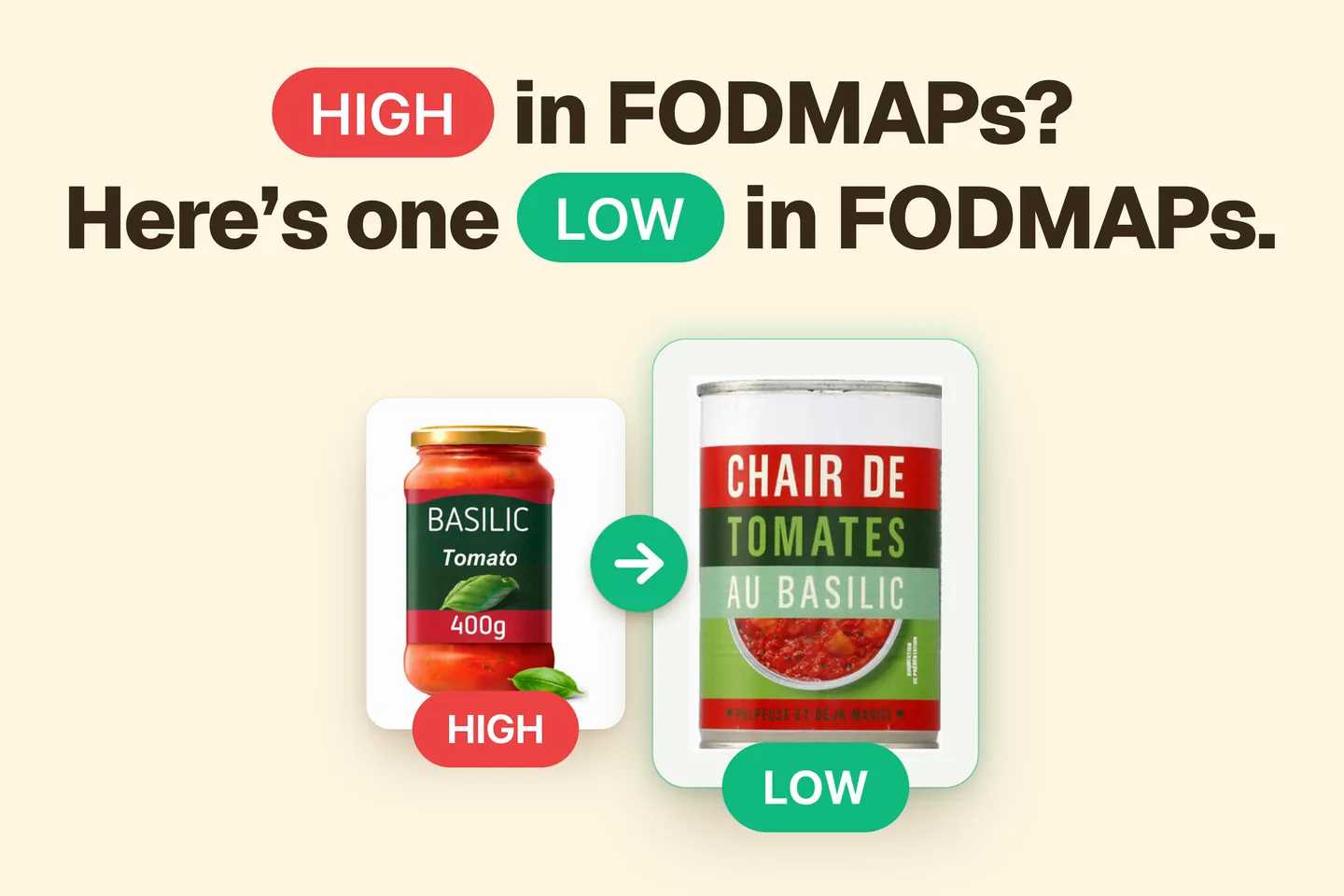
To find a low FODMAP swap at the supermarket, first find the ingredient that makes the product high in FODMAPs. Then choose a product that does the same job without it, and check its whole ingredient list and the portion you will eat. When a scanned product is not rated low, Belly Buddy suggests up to three alternatives.
Find the ingredient behind the rating
A packaged product is often high in FODMAPs because of one or two ingredients, not the whole recipe. A tomato sauce can be mostly tomatoes, with onion further down the list. Find that ingredient first. It tells you what your swap should not contain.
These declared ingredients often change the FODMAP profile of a packaged food. Next to each one is where a swap usually starts.
- Onion and garlic, including powders, in sauces, soups, stocks, crisps and ready meals. Both are rich in fructans. Choose a version without them. For home cooking, garlic-infused oil and the green tops of spring onions give flavour, as our garlic and onion guide explains.
- Wheat, rye and barley in bread, pasta, crackers and cereals. These grains contain fructans. Rice, corn, quinoa and oats are common bases for a swap, in the portions the Monash University app lists. Oat serves are limited. Some sourdough breads also have a low FODMAP serving. Our sourdough guide explains which ones.
- Inulin, chicory root fibre and FOS, often added to "high fibre" or "gut-friendly" yoghurts, bars and cereals. They are sources of fructans. The swap is often the same type of product without the added fibre.
- Honey, agave, fructose and high fructose corn syrup in granola, cereal bars, sauces and dressings. They carry excess fructose. Monash University lists maple syrup, rice malt syrup and table sugar among its low FODMAP options, so a product sweetened with one of these is a good place to start.
- Apple or pear juice concentrate, used to sweeten "no added sugar" snacks, juices and fruit spreads. Apple and pear juice also carry excess fructose. Choose a version with a different sweetener.
- Polyols, such as sorbitol, mannitol, maltitol, xylitol and isomalt, in many sugar-free sweets, gums and protein bars. The swap is usually a version without polyols. Our sweeteners guide compares the common ones.
- Milk, milk powder and whey contain lactose. Cream has little lactose, so the amount matters. Lactose matters only if you do not absorb it well. Lactose-free versions are the usual swap. Our article on lactose-free vs low FODMAP explains why lactose-free covers only one FODMAP.
- Soy, lupin and other legume flours in some gluten-free pasta and snacks. They contain GOS. Pasta made from rice, corn or quinoa is a common swap.
This list is a summary. Our checklist of hidden FODMAPs explains each term in more detail, and our low FODMAP shopping list covers the shop aisle by aisle.
The low FODMAP diet is meant for people with IBS, ideally with guidance from a dietitian. The strict phase of the diet is temporary. Monash University describes it as lasting 2 to 6 weeks. During reintroduction, you may find that you tolerate some of these ingredients in certain amounts. The list of swaps you need can then get shorter.
What makes a good swap
It does the same job. A good swap replaces the product in a meal you already make: a pasta sauce for a pasta sauce, a cereal for a cereal. A swap that fits your usual meals is easier to keep.
The culprit is gone, and nothing new replaces it. A "free from" claim covers one thing only. A gluten-free bread avoids wheat, rye and barley, but it can contain inulin, apple fibre or legume flour. A lactose-free yoghurt can contain fruit concentrate. Read the full ingredient list of the swap, not only the front of the pack.
It has a low FODMAP serving at the portion you eat. Low FODMAP describes a serving, not a food in any amount. Tinned tomatoes, for example, are low FODMAP in a standard serve in Monash University testing. A larger portion adds more FODMAPs, and the Monash University app gives the serve size. Several low FODMAP foods at the same meal can also give a higher total, which is called FODMAP stacking. Our article on FODMAP serving sizes explains why.
Vague words may need a check. Terms such as "spices", "seasoning" or "natural flavouring" can hide onion or garlic. Labelling rules vary between countries. When a term is unclear, ask the manufacturer or check the Monash University app.
Read the label of your swap again from time to time
Manufacturers change recipes. A product with a short ingredient list last year can have a different list today. When a familiar pack looks different, read the label again. Recipes can also vary between countries, so the same brand abroad may not have the same ingredients.
An example: tomato and basil pasta sauce
Say you find a jar of tomato and basil pasta sauce. Onion is on the ingredient list, and Belly Buddy rates the sauce high in FODMAPs because of it.
The app then suggests a tin of chopped tomatoes with basil, sold in your country. It is rated low because every ingredient on its label is rated low. It does the same job: warm it with a little garlic-infused oil and fresh herbs, and you have a pasta sauce.
Let Belly Buddy suggest the swap
Comparing labels takes time, especially in your first weeks. When you scan a barcode with Belly Buddy and the product is not rated low, the app shows up to three low FODMAP alternatives sold in your country, based on Open Food Facts data. It suggests a product only when the product is rated low overall and every ingredient on its label is rated low too. Tap an alternative to see its full analysis.
Sometimes the app shows no alternative, because there is no match in your country yet. Belly Buddy works only with what the manufacturer declares on the label, and it cannot predict how your gut will respond. Formulations can change, so check the label of the product you buy. Our rating method explains how Belly Buddy analyses ingredients and reaches a verdict.
Our ratings rely on the public research of Monash University. Belly Buddy is not affiliated with Monash University.

Looking for a low FODMAP swap?
Scan a product with Belly Buddy. If it is not rated low FODMAP, the app suggests up to three low FODMAP alternatives sold in your country.